
What Is Page Yield? How to Calculate Your Real Cost per Page
| Aug 29, 2026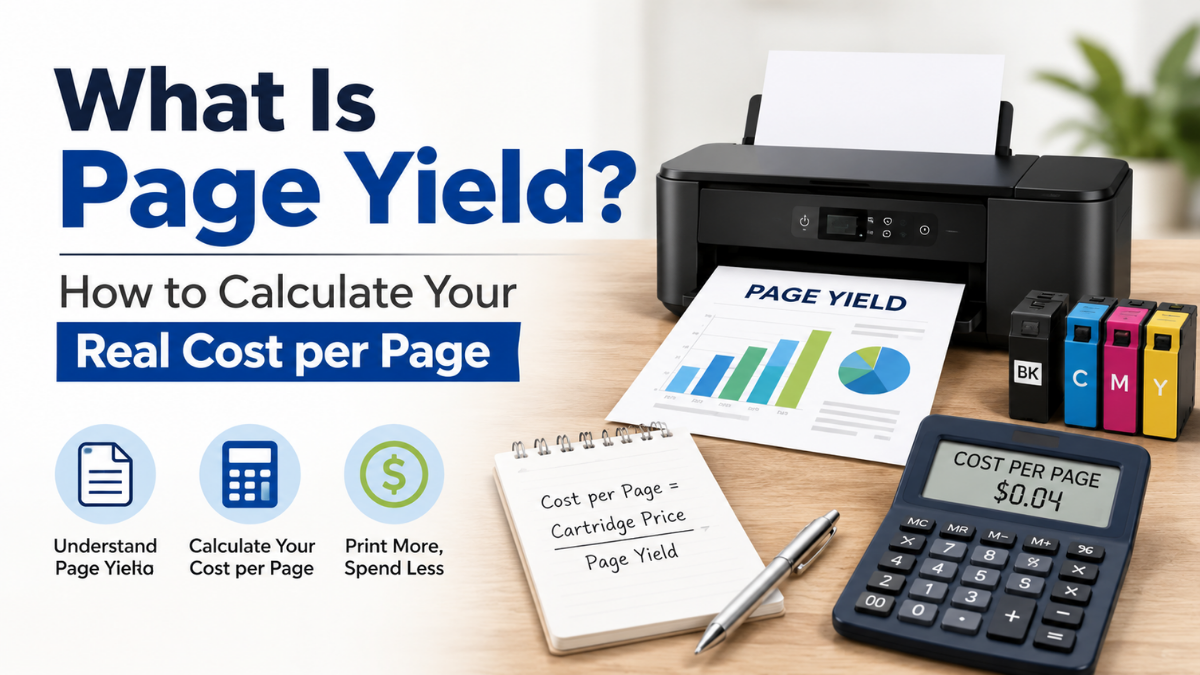
Buying printer ink can feel like a simple decision: find a cartridge that fits your printer and choose the one with the lowest price. But there’s another number you should check before you buy—page yield.
Page yield tells you approximately how many pages a cartridge can print before it runs out. Understanding its page yield meaning can help you compare cartridges more fairly, especially when deciding between standard and high-yield options.
In this guide, we’ll explain what page yield means, how page yield in printer cartridges is determined, and how to calculate your real cost per page. We’ll also show why the cheapest cartridge isn’t always the most economical choice.
What Is Page Yield?
Page yield is the estimated number of pages a printer cartridge can produce before the ink or toner runs out.
For example, suppose a black ink cartridge has a page yield of 300 pages. Under the testing conditions used by the manufacturer, that cartridge is expected to print approximately 300 pages.
However, page yield is an estimate—not a guarantee that every user will get exactly the same number of pages.
Your actual results can vary depending on what you print, how often you print, your printer settings, and other factors. A document containing mostly text will generally use less ink than a page filled with large images or heavy graphics.
If you want to understand the page yield meaning in practical terms, think of it as a cartridge’s estimated printing capacity.
Why Does Page Yield Matter?
Page yield becomes especially useful when comparing cartridges with different prices and capacities.
A cartridge that costs less upfront may not necessarily be cheaper to use. For example:
- Cartridge A costs $15 and prints 200 pages.
- Cartridge B costs $25 and prints 500 pages.
Although Cartridge B costs more initially, it produces more pages for the money.
This is why looking at page yield alongside cartridge price gives you a better idea of what you’re actually paying for each printed page.
If you’re trying to estimate your overall printing expenses, a printing cost per page calculator can also make the comparison easier.
Page Yield Meaning: How Is It Calculated?
Now that we’ve covered the basic page yield meaning, it’s important to understand how manufacturers arrive at the number shown on a cartridge package.
Printer manufacturers use standardized testing methods to estimate how many pages a cartridge can print. For many ink cartridges, the testing is based on a page containing a specific amount of ink coverage, often around 5% for black-and-white text printing.
This means the test page uses a relatively small amount of ink.
Real-world printing is often different.
If you regularly print presentations, photos, colorful graphics, or documents with lots of bold text, you may use more ink per page than the standard test assumes. As a result, your cartridge may run out sooner than its advertised page yield.
This doesn’t necessarily mean the cartridge is underperforming. It simply means your printing habits are different from the conditions used for testing.
Understanding Page Yield in Printer Cartridges
When shopping for ink, you’ll commonly see cartridges described as standard-yield or high-yield (XL).
Standard-yield cartridges generally contain less ink and have a lower page yield. They’re often suitable for people who print occasionally or don’t need a large amount of ink at once.
High-yield cartridges contain more ink and are designed to print more pages before needing replacement.
For example:
| Cartridge | Price | Page Yield | Approx. Cost per Page |
|---|---|---|---|
| Standard | $20 | 200 pages | $0.10 |
| High-Yield | $35 | 500 pages | $0.07 |
The high-yield cartridge costs more upfront, but its lower cost per page makes it the better value if you print frequently.
If you’re a regular printer, it’s worth learning more about the benefits of high-yield ink cartridges before automatically choosing the cartridge with the lowest sticker price.
How to Calculate Your Real Cost per Page
Calculating your printing cost doesn’t have to be complicated.
The basic formula is:
Cost per page = Cartridge price ÷ Page yield
For example, imagine a cartridge costs $24 and has an advertised page yield of 400 pages.
$24 ÷ 400 = $0.06 per page
Your estimated ink cost is therefore 6 cents per page.
You can use this calculation to compare different cartridges, even when their prices and page yields are different.
Example: Comparing Two Cartridges
Let’s say you’re choosing between two black ink cartridges:
Cartridge A
- Price: $18
- Page yield: 250 pages
- Cost per page: $18 ÷ 250 = $0.072
Cartridge B
- Price: $30
- Page yield: 500 pages
- Cost per page: $30 ÷ 500 = $0.06
At first glance, Cartridge A appears cheaper because it costs only $18. But Cartridge B actually costs less for every page you print.
This is why page yield is such an important number when comparing printer supplies.
What About Color Printing?
Color printing can be a little different because color printers typically use multiple cartridges.
A color printer may use separate cyan, magenta, yellow, and black cartridges. If you’re calculating the cost of a color page, you need to consider the cost and estimated yield of the cartridges involved.
For a simple estimate, you can add the costs of the cartridges used and compare that total with the expected number of pages.
Keep in mind that your actual color printing costs can vary significantly depending on how much color each page contains. A page with a small colored logo may use considerably less ink than a full-page photograph.
Does a Higher Page Yield Always Mean Better Value?
Not necessarily.
A higher page yield can be a good thing, but you should always compare it with the cartridge’s price.
Imagine these two cartridges:
- Cartridge A: $15 for 250 pages
- Cartridge B: $40 for 1,000 pages
Cartridge B has a much higher yield, but the real question is how much you’re paying per page.
Cartridge A: $15 ÷ 250 = $0.06 per page
Cartridge B: $40 ÷ 1,000 = $0.04 per page
In this example, the higher-yield cartridge offers better value.
However, there’s another consideration: how much you actually print.
If you only print a few pages each month, buying a larger cartridge may not make sense simply because it has a higher page yield. For frequent printing, however, the convenience and lower cost per page of a high-yield option can be worthwhile.
Why the Cheapest Printer Ink Isn’t Always the Cheapest
It’s tempting to search for cheap printer ink when you’re trying to save money. But the cartridge with the lowest purchase price isn’t always the one that saves you the most.
Instead of looking only at the price tag, consider:
- Cartridge price
- Page yield
- Cost per page
- Your average monthly printing volume
- Whether you need standard or high-yield capacity
- Whether you’re buying individual cartridges or multipacks
This approach gives you a clearer picture of the cartridge’s long-term value.
For example, paying $10 for a cartridge that prints 100 pages may seem better than paying $20 for one that prints 300 pages. But when you calculate the cost per page, the second cartridge may be significantly cheaper to use.
Other Factors That Can Affect Your Printing Costs
Page yield is useful, but it’s only one part of the bigger picture.
Your actual printing expenses may also be affected by:
Print quality settings: Higher-quality settings can use more ink.
Type of documents: Photos, graphics, and pages with heavy text coverage generally consume more ink than simple text documents.
Printer maintenance: Some ink can be used during automatic cleaning and maintenance cycles.
Paper: Ink is only one part of the total cost of producing a printed page. The type and price of paper can also affect your overall expenses.
Printing frequency: Someone who prints 10 pages a month will have very different needs from a small business printing hundreds of pages every week.
If you’re comparing printer technologies, it’s also useful to consider inkjet vs laser ink cost, since the ongoing cost structure can differ between inkjet and laser printers.
How to Get Better Value From Your Ink
Once you understand page yield and cost per page, you can make smarter purchasing decisions.
Here are a few simple tips:
Compare page yield before buying. Don’t judge cartridges by price alone.
Calculate the cost per page. Divide the cartridge price by its estimated page yield.
Consider high-yield cartridges if you print frequently. A higher upfront price may result in a lower cost per page.
Match cartridge size to your printing habits. Occasional printers may not need the largest cartridge available.
Consider your typical documents. Heavy color or image printing can reduce your actual yield.
Compare the total cost, not just the cartridge price. Include paper and other printing-related expenses when budgeting.
Final Thoughts: Use Page Yield to Find the Real Value
Understanding page yield makes it easier to look beyond the price printed on a cartridge box. The page yield meaning is simple: it tells you approximately how many pages a cartridge is expected to print. But the real value becomes clearer when you combine that number with the cartridge price and calculate your cost per page.
Before buying your next cartridge, compare its page yield, calculate the estimated cost per page, and consider how much you typically print. A cartridge with a higher upfront price may actually save you money over time, while the cheapest option isn’t always the most economical.
Once you understand page yield, you can make more informed printing decisions and choose ink or toner that gives you better value for the pages you actually print.
Frequently Asked Questions
1. What does page yield mean on a printer cartridge?
The page yield meaning refers to the estimated number of pages a cartridge can print under standardized testing conditions. Your actual page yield may be higher or lower depending on what and how you print.
2. What is a good page yield in printer cartridges?
There isn’t one page yield that’s best for everyone. A good page yield in printer cartridges depends on how often you print. Occasional users may be fine with standard-yield cartridges, while frequent printers may benefit from high-yield options.
3. Is a higher page yield always cheaper?
No. A cartridge with a higher page yield may cost more upfront. To determine whether it’s actually cheaper, divide the cartridge price by its page yield to find the estimated cost per page.
4. Why don’t I get the advertised page yield?
Advertised page yield is based on standardized testing conditions. If you print pages with lots of images, graphics, bold text, or color, you may use more ink per page and get fewer pages from the cartridge.
5. Should I buy standard or high-yield ink?
It depends on how much you print. Standard cartridges can be suitable for occasional printing, while high-yield cartridges can offer better value and fewer replacements for frequent printers.